Saturday, January 1, 2011

Catching trophy trout


Reflections of catching trophy trout- challenges and rewards from a South Island perspective.

The trophy trout formula

Peter Langlands


After ten years of local fly-fishing I am now sure that catching trophy trout is often by planning and less by accident. Trophy trout (say fish over 3.5 kilograms) often occur in the same locations year after year. They have what is termed a high level of “site fidelity”, and given the fact that the trout often take up residency, and can live for up to ten years, often the same trophy fish will be re-encountered in the same location. Also after a while you reflect on the circumstances in which trophy fish were caught and common themes start emerging, despite the geographically diverse range of locations from which trophy fish are caught, there are several common factors. The opportunities for fishing new waters based from my home in Christchurch are vast, and even after ten years there are Wilderness Rivers, containing trophy trout, within 50 miles straight-line distance of the city that I have yet to fish! I look forward to applying some common themes and encountering trophy trout in some new waters.
Lets run through the formula.

Trophy fish like areas, which have stable environments. Often these stable environments occur in the rivers’ head-water regions. Stable riverbeds have the greatest diversity of insects and often proportionally a higher abundance. Also the headwater rivers have more edge environments relative to the flow of water, than the river has further downstream. The increased proportion of edge environments also increases the availability of terrestrial food sources. Often the head-water rivers will have a variety of gravel environments from fine pebble to large boulders and this diversity in stone size will allow a higher diversity of insects to thrive.

Yet as a qualification rivers that have frequent freshes, as opposed to large floods, will often have the most productive insect populations. The head-water rivers are often in areas of high rainfall. It is often while the river is slightly coloured after a fresh that the trout will feed most actively, and if the river has had high angling pressure, the trout will often be relatively easy to catch at such times, as they are more easily deceived in the discoloured waters.

Another common requirement of trophy trout is that there are some sanctuary points such as a large tree fallen into the river, an undercut bank, a deep pool nearby, or a cluster of large boulders, or large open runs, where the trout can hold well clear of the edges and “feel safe”. The more permanent these features are in the river, the higher the chances are that trophy fish will be found there.


Often trophy trout will be located in a pocket of quiet water next to
the main current, where the flow acts as a giant conveyor belt. Trophy fish need to be located next to an area where the main flow is focussed through a small space, but which has some cover nearby, as they need to optimise their feeding. Often such lies will be in heavy water and the large trout will lie deep next to boulders, where they can hide in the smallest spaces. Experience has shown me that trout love holding in these pocket water spaces as they seek more cryptic lies in response to the angling pressure nowadays. Trophy browns are also invariably close to the river’s main flow.

Another factor to consider when seeking out fish above the average size is that often rivers with fewer fish will have larger fish! Many rivers are characterised by a standard sized trout, such as many waters on the South Island’s West Coast, where the trout will average 2 to 2.5 kilograms. Given the moderate numbers of fish, and competitive feeding situations, trophy trout are less likely to be found in these rivers.
If you are fishing a river with a wide variation in trout size, the signs are promising that the river may hold trophy fish. Especially in the upper reaches.

There is also no doubt that certain region’s consistently hold trophy trout such as the rivers in the Lewis Pass. The environment is rugged enough to flush out the smaller fish, yet stable enough to allow larger trout to thrive. It is this ratio in which trophy fish will be encountered. Often there is also what my brother Martin terms “a golden ratio”, in which certain sized rivers are most likely to have trophy fish. Many rivers, which consistently have trophy fish in them, are in the 3-15 cumecs (cubic metres of water per second) range, (and often in the 5-12 cumecs range to be more specific). These rivers have the perfect ratio of flow to have enough insect life to support large trout, but also have a high proportion (to flow) of river bank habitat, and are large enough to afford the trout enough flow to seek sanctuary in. Trophy fish love the medium sized rivers.

A mix of habitat types around the river is another factor to consider as well. We all know that rivers with patches of beech forest, which the mice will move between, fish outstanding well in beech mast years. Rivers with stable edges, in which a diversity of algae grows, will often be places that attract trophy fish, as the mix of algae allows a diverse range of insects such as caddis flies to flourish.

Finally seek out the remoter rivers by all means; as they will often have the highest portion of trophy fish. But also stay open minded. If you spot a good pool next to a bridge, checked it out, as often anglers will race away from their cars and overlook such locations. It is the old saying sometimes- “fish your feet first!”

Another part of the trophy trout formula is getting in on the scene early in the season. November to December are prime months. Lets look at some trophy trout locations through the regions. These are well known for being consistent trophy trout produces and worth a look, but also stay open-minded and follow your own judgement. Some pointers………….

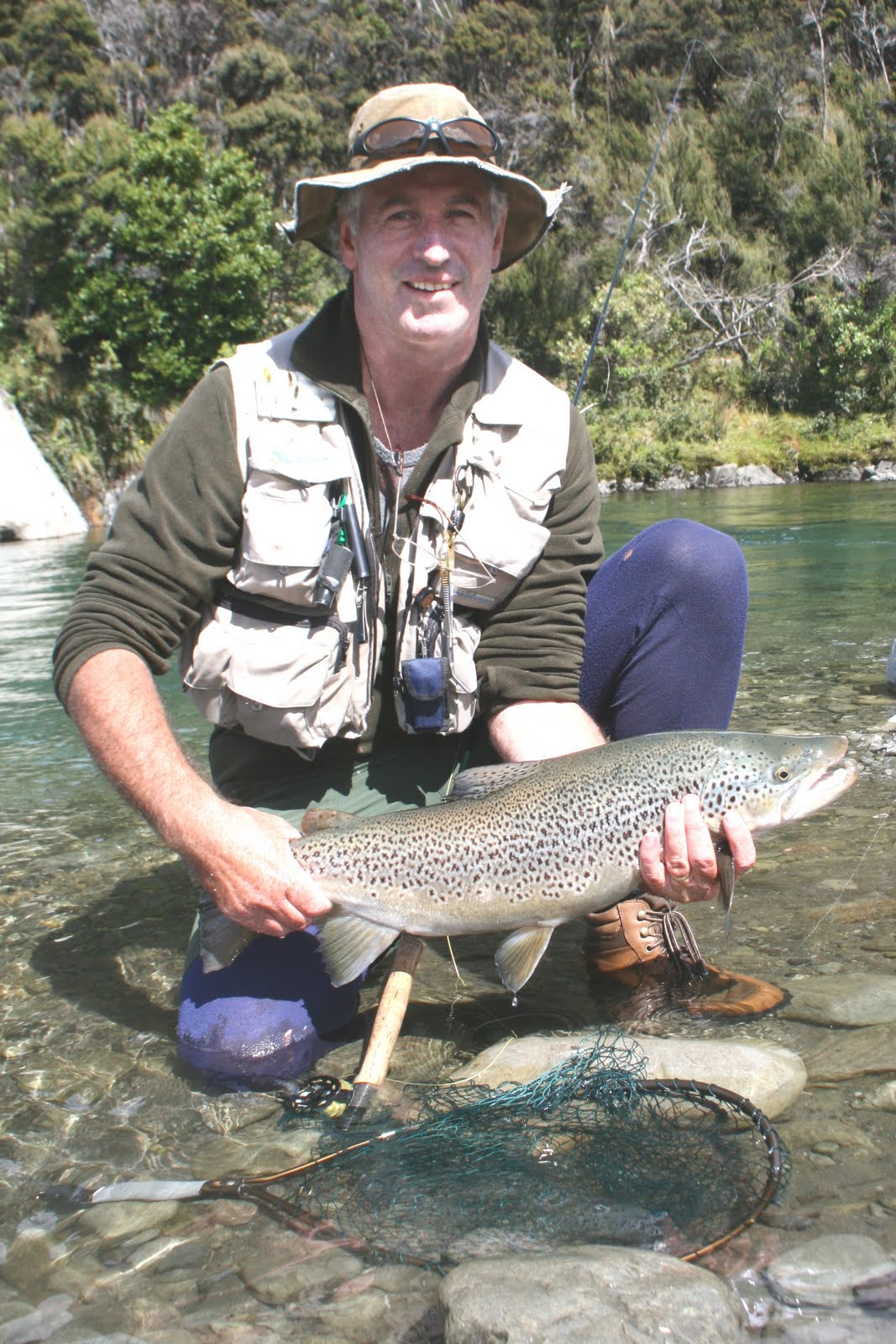
Trophy trout taken from Lewis Pass Region


Taken on a Langlands brown soft hackle

high water fishing tactics

Flyfishing in discoloured water conditions
Flyfishng often works at it’s best in clear water. Fly fishing generally requires clearer water to be effective than other techniques such as spin fishing. Generally need at least 60 centimetres of visibility to be effective.
Yet when the water in the main river has less than 60 centimetres visibility fly fishing can still be effective. Lets look at some on the situations and techniques which are used to make fly fishing effective in discoloured waters.
Often when fishing discoloured waters large black or purple lures (or florescent green , or ideally a combination of both combined into a hairy go type pattern) are effective. I like patterns which have lots of soft material that will move in the water and attract the trout’s attention. Woolly buggers, Black rabbits, and large fuzzy Wuzzy’s are proven patterns in disclosed waters as the trout can “hear“ the movement of the lure material on their lateral lines. When fishing discoloured lake edges’ or when targeting sea run trout (or on occasions salmon) at river mouths I use these patterns. They are also very effective on the Canterbury lure rod . Often trout will chase baitfish such as smelt and bullies into shingle shallows or along shingle banks on lake edges and these are prime spots to try, especially late in the evening when the trout can be seen swirling in the discoloured waters along the lake’s edge (such as at lake Forsyth). Lure fishing comes into its own in discoloured water As it is easier to deceive trout, than fishing clear waters and also explains why lure fishing is especially effective during periods of low light such as dawn and dusk. Luminous lures also work very well in discoloured waters when targeting rainbows at night.

Large black lure are also effective when swang down and across on a sinking line, especially along the river edge where the water will clear up slightly and is a favoured location for trout to ambush their prey in the discoloured waters. Lures are often at there most effective in discoloured waters in rivers such as the Tongariro. A good spot to fish lures when the main river is dirty is to look for a clear flowing side channel or stream and fish along the edge of the clear and dirty water. Keep casts short and close to the rivers edge in such situations.

On rivers discoloured water offers the challenge of having to use a fly which the trout can easily see. Trout will often feed with less caution in discoloured waters after heavy rain. Therefore aiming to fish rivers immediately after a flood can be vert rewarding, especially on headwater rivers ion the high country where the trout have become extremely cautious feeders during the periods of clear flow.

I have found large black tungsten bead heads to be especially effective in discoloured flows, especially when fishing deep pools. The black bead head has a strong profile in the water. It also imitates the wing case of the toebiter which is often dislodged during floods and a rpime food source for trout early in the season. The beadhead will be close to the bottom where the trout will be feeding as the rivers current slows down with the fiction against the stones. Black beadheads are very effective when fishing discoloured flows on small stream as they sink quickly in spaces where over hanging vegetation nescessitates a short cast.


Often it pay to fish larger flies in discoloured waters and I often use a size 10 or 12 nymphs. Flashback nymphs wor nymphs with some sparkle on them will attract the trout’s in discoloured waters. I also like using a brightly coloured florescent green free living caddis with a flashback in discoloured waters. Bright green shows up well in discoloured water. If you are targeting rainbows then glo-bugs work well in discoloured waters.


Often when nymphing in discoloured waters in pays to fish the prime lies such as ledges and the fall ins of pools. You will have to make more casts than normal to make sure than if there is a trout there it sees you fly.

On occasions trout will also take large dry flies when the river is discoloured. This has happened to me on numerous occasions when fishing the South branch of the Hurunui River. For this reason when nymphing in discoloured water I use a large black indicator fly, which serves a dual purpose of being an imitation of a large terrestrial to tempt the trout through the murky water to the surface. On larger stony rivers trout will take mayfly duns on the edge, so be diligent and open minded to the possibilities when fishing discoloured waters.
If after several hours fly fishing discoloured waters, with no success, then it pays to switch over the spin fishing clear, which is effective in half the visibility that fly-fishing requires to be effective. Trout will readily hit spinners in water of only 30 centimetres visibility when spin fishing. The blade spinners, black spinners and Rapala patterns are effective in discoloured waters. (Black Toby in discoloured water at Lake Forsyth)

Fishing foam beetle flies

Fishing beetle flies

One of the most important terrestrial foods for trout is beetles. In the south there are two species of beetles which are recognised by anglers as being seasonally important food sources for the trout. The brown beetle and the green beetle. There is a third type of fuzzy brown beetle which is also important to trout, for a longer period of the year than many people realise, but will not be discussed here.

The brown beetle hatches out from early November onwards and is particularly characteristic of lowland areas where there are improved pastures. Lowland streams come alive just on dusk as the brown beetles hatch out and, some accidentally crashing onto the water on dusk. The trout will come out from underneath undercut banks and from under neath trees to take the brown beetles buzzing on the surface in a frenzied panic. The trout’s rise lasts for up to an hour after dusk. Warm nights, especially with a north westerly breeze, provide the best conditions. Some large trout can be caught on beetle flies. I caught a seven pounder in the LII on dusk on Christmas eve a few years ago. The trout took 45 minutes to subdue, by which time the rise was over. The brown beetle hatch is most prolific around Christmas time and dies away by late January.

By early December the manuka trees start flowering and the green beetle hatches out in vast numbers. These small metallic green beetles fall onto the waters’ of high country lakes when a gentle breeze starts up. Sometimes it take the trout a while to cue onto these beetles, but once the rise starts, normally around 10am and it will go until mid-afternoon, by which time the trout have often filled themselves up on a bounty of beetles and cease feeding. Often the trouts’ rise to the green beetle is very subtle. Having a low profile beetle fly that sits in the surface film works well. Especially on cautious fish that shy away from high floating dry flies. Also on many high country lakes the trout will take a green beetle dry when there is no apparent surface rise. The trout will often discretely sip the beetles in.

I like to tie a green beetle pattern with a chestnut hackle under a small black foam body, which has a sheet of metallic green ribbon over the top. The fly flickers from the chestnut hackles on to the green when it turns on it’s side. The fly is quite discrete so it must be watched carefully . The green beetles fall on the water until mid-March (much latter in the season than many people realise) and offer a chance to catch trout in many of our high country lakes. The green beetle fly is also effective when fishing headwater rivers to well educated trout. At times when fishing to educated trout I will take the green back of the fly and fish a “black beetle“, which has worked well for me at locations such as Lake Marymere. The chestnut hackle is I believe a key trigger in both brown and green beetle patterns. Foam flies can be realistically shaped and are easy to tie. I use either a size 12-14 hook for beetle patterns.

So far I have referred to beetles as floating on the surface. Yet as time goes by the beetles slowly sink, so fishing a beetle imitation as a nymph, under the surface is also highly effective, yet over looked. The weighted beetle fly is fished underneath a large black dry fly, such as a Black Gnat, or underneath an indicator and allowed to drift along foam lines along the lakes’ shore. But that’s another story…

Brown beetle mayhem


Brown beetle mayhem
From mid-October onwards-brown beetles emerge from the ground and take flight. Being feeble fliers they often crash onto the water when the breeze blows, and become an important part of the trout’s diet in may lowland streams. Brown beetles often start flying about half an hour before dusk, and just after dusk, so the fishing can be intense over this window of opportunity.

Often the trout will rise on a station and maintain that spot for some time. Look close along the banks, as often the trout will choose a secluded spot to rise from. Make sure that you arrive at the river at least half an hour before dusk. The fly should be cast several metres upstream from the rising trout. Takes are often gentle slurps, so a slow, but steady striking action is best. Often it is important to have a good landing net, as rivers with steep, overhanging grassy banks, are often the best ones for fishing.

About an hour after the start brown beetle rise the trout will stop rising. At these times it is worth swinging a small, but heavily weighted woolly bugger in the current to attract the attention of trout taking sunken brown beetles below the surface. Also at dawn, often the trout will be feeding on sunken beetles, and fishing a brown beetle nymph is highly effective.

The brown beetle is mainly a lowland speceis, so it is best to check out lowland rivers around productive farmland. But in the high country an larger speceis of brown beetle will hatch out, over much of the year and blind fishing a “brown beetle nymph” underneath the foam line, or off any points projecting out into the lake can be highly effective. Brown beetle fishing is often best from mid November, and in December, and is an angling experience that I associate with Christmas time.

Top foam beetle pattern available


#14x 6-
a top dry fly - especially for sight fishing to tough browns on lake edges- has worked well on Lake Marymere- the hardest trout of all !!!
http://www.trademe.co.nz/Browse/Listing.aspx?id=344396303

Ten top tips for successful trout fishing.


Ten top tips for successful trout fishing.


1.Many of our rivers have low numbers of trout and are not suited to the beginner angler. Find out locally about a river that has moderate numbers of small to average sized fish and spend some time building up your confidence there. You need to get a good number of strikes to improve this “reflex skill”.

2.Try using black dry flies, or dull coloured dries and avoid using flies with bright colours or white on them, as when the water has been fished through trout, especially browns, shy away from bright colours. The same can also be said of nymphs. Keep them dull and naturally coloured, especially when targeting larger browns.

3.Keep your clothing naturally coloured. In particular avoid white coloured hats and bright coloured clothing. Also avoid using your hands to point out a trout, as the sudden white flash of your hands will scare the fish. For this reason I like to wear a pair of dull green fingerless gloves. Keep movements to the absolute minimum when stream side.

4. Following on, often the most unnecessary movement occurs when people reach towards the leader, to pull the end of the fly line through the rings. This action causes a lot of disturbance and movement, often scaring trout. Therefore it is important to remove loop connections, and instead have a slim-lined knot connection that will slide through the rings of the rod, and allows the leader to be cast out, rather than manually pulled out. The unnecessary movement of your hands, and the rod, when pulling the fly line through will often spook trout on smaller rivers.

5. Make a point of placing a collar of soft-hackle on your flies. The feather will move naturally in the water imitating the legs and wing case (of emerging insects) and is often a trigger causing trout to take the fly.

6. Often when blind fishing on rivers it pays to cover the water and not spend too long in one spot. Often the first few casts give you the best chances of catching a trout. After the initial casts the trout become spooked and are less likely to take a fly. So move on to “fresh” water.

7. Often foam lines are good markers for the feeding lanes that trout have in the river, so concentrate on these locations to both spot trout, and also to blind fish your flies through. Often crippled emergers and other insects, such as willow grubs, will be concentrated in the foam lines.

8. When nymphing many anglers miss catching fish through simply not striking quick enough. My saying is when it comes to nymphing- “is to hesitate, is to be too late”. After a while you will almost strike on instinct. You often don’t have that much to lose by being “trigger happy”, compared to those fish you will miss through a delayed strike response.


9. Also don’t rely on your indicator to register when a trout has taken your nymph. Often trout will swim downstream, with the drifting nymph, so the indicator will not move, when the trout takes. If you see the trout’s white mouth flash, or a sudden turn, then strike.

10.Don’t be hesitant about changing the depths of your nymphs. Often it pays to set the nymphs to drift just above the bottom. An added advantage of constantly retying your line is that the knots stay fresh. It is important to re-tie on your beadhead nymph after each fish, as often the knot will become worn, either through contact with the stones, or the trout’s mouth.